
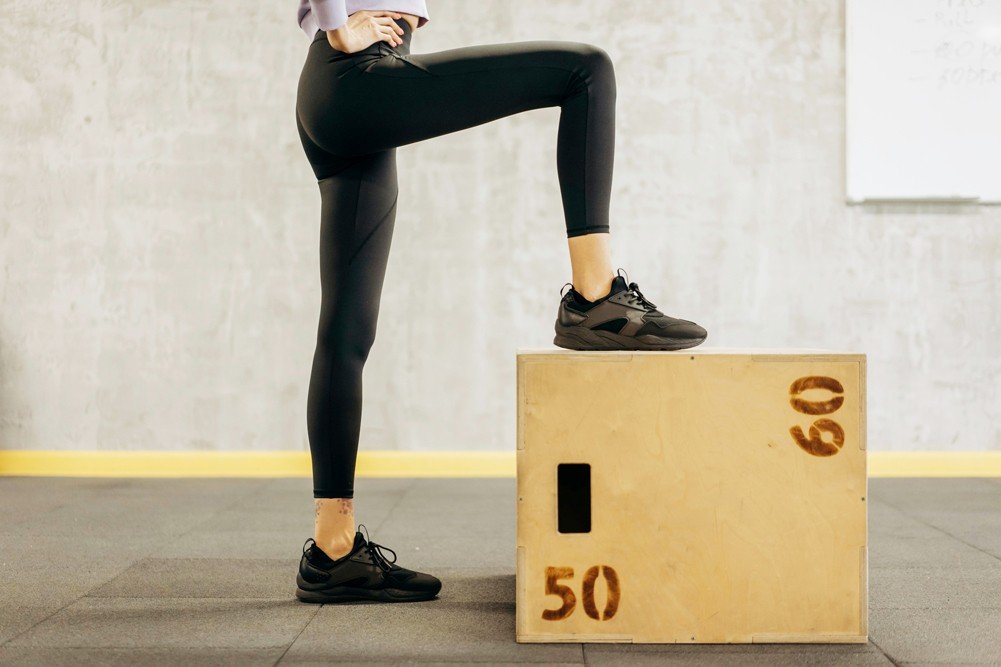
The weighted step is one of the most powerful and simple movements for maintaining strength and balance as you age.
There is a quiet strength in walking. jump Not racing. It is not necessary. Just lifting your body with intention and trusting it to carry you. Weighted step-ups are one of the most overlooked movements in modern fitness, but they train the body just as life demands: stairs, curbs, uneven terrain, getting up and down with confidence. It is a real powerhouse that is portable, functional and protective. Stepping is a unilateral movement, meaning one leg works at a time while the body braces itself against gravity. It reflects how we move around the world and makes the steps for long-term health unique. Walking is not just a leg exercise. They are a whole-body, brain-to-body coordination practice that builds strength, stability, and confidence in movement.
What makes the steps so effective?
Each repetition requires the body to:
- generates power through one leg
- stabilize the pelvis and spine
- coordination of balance and breath
- move through the joints in a natural and functional range.
This combination makes this exercise unique for long-term health.
Steps improve balance and prevent falls
When you step onto the platform, your nervous system must immediately assess your balance, joint position, and load. Over time, this sharpens proprioception, your body’s ability to sense where it is in space, which is essential for preventing falls and moving confidently.
Original stability without pressure
The core’s main role is to transmit force and resist unwanted movement. During the lift, the core stabilizes the body against rotation and lateral movement, activating deep muscles such as the transverse abdominis and pelvic floor without straining or overstressing.
The power of mutual support
Step-ups strengthen hamstrings, quadriceps, hamstrings and calves while encouraging proper knee tracking and hip control. When performed with good coordination, they provide protection for the knees and spine, making them suitable for all ages and fitness levels. This cross-body coordination improves movement efficiency, posture, and stability, not just strength.
Why steps become important as we age
From the age of 40 we naturally experience a decline in muscle mass, balance and bone density. Confidence in movement can decline as quickly as physical ability. Walking directly addresses these changes by loading the bones of the ankles and feet to support bone density, maintain leg strength, maintain mobility, and train the body to manage the load safely when carrying objects. If your goal is independence, longevity and freedom of movement, these exercises are not optional, they are fundamental.
One of the biggest advantages is its accessibility. They require minimal equipment and adapt easily to different environments. You can find them at:
• park using a chair or step
• a house on a staircase or a strong box
• office with a low platform. Adding dumbbells or kettlebells increases strength and load on the bones, while bodyweight variations improve balance and control.
9 VARIATIONS OF STEPPING AND STEPPING
Try this strength workout that can be done anywhere. Add it to your weekly routine. Use these to gradually build strength, stability and mobility. Make sure you have a stable platform.
- Basic Slow, controlled ascent and descent. Focus on full foot contact and straight posture.
- Heavy Hold dumbbells or kettlebells at your sides to increase the load on your legs and hamstrings.
- Goblet Hold a weight at chest height to increase core engagement.
- Side step raises from the side to strengthen the core and improve lateral stability.
- Knee Driver Drive the back knee up to test your balance and hip flexors.
- Lower the eccentric slowly (3-5 seconds) to strengthen the knees and improve control.
- Cross Body Hold the weight in the hand opposite the working leg to train the fascial slings and counter-rotation.
- Low Box Movement Use a low squat and emphasize ankle and hip range of motion.
- Tempo Pause at the top or bottom to release momentum and create deep stability.
The steps may be simple, but their impact is profound. They provide strength that goes into real life, strengthen balance and coordination, and support the body through the natural changes of aging. If you want a movement that protects your joints, strengthens your core, and keeps you fit for decades to come, start with the basics. Sometimes the most powerful thing you can do for your body is to simply move up.


