

Feeling stiff every morning? Try this 5-move routine instead of another hot shower.
Most of us love a hot shower to relax solid body in the morning, and one reason it feels not so good. The heat of the water raises the temperature of the skin and causes blood vessels near the surface of the body to dilate. This can increase blood flow, reduce stiffness, or help muscles and joints feel more comfortable.
Your heart rate may even increase slightly as your body works to regulate the extra heat. But there is an important limitation. A hot shower primarily warms your body from the outside in, where exercise warms your body from the inside.
When your muscles begin to contract, they use energy, and most of it is released as heat. As more muscles are involved, your core temperature gradually rises, your heart starts pumping faster, blood circulation improves, and oxygen and nutrients are transported throughout the body. This is one of the reasons why movement in the morning is most effective.
During sleep, body temperature naturally decreases, heart rate slows down, blood circulation changes, and the body remains relatively calm for several hours. This can cause stiffness and weakness in many people when they first get out of bed, especially after age 60. The purpose of morning exercise is not necessarily to perform strenuous exercises.
You don’t have to strain yourself, lift heavy weights, or spend hours exercising. The goal is to transition your body from rest to activity. These exercises are designed to gradually recruit more muscles, increase circulation, gently raise your heart rate, and generate heat from within.
Exercise gives you benefits that a hot shower can’t. As you move your joints, your nervous system receives information about your body’s position, balance, coordination, and movement. This helps to awaken communication between the brain and muscles, something I call proprioception.
Movement also helps circulate synovial fluid within the joints. That fluid acts somewhat like a lubricant, and when the joint moves, it spreads over the surface of the joint, helping to support smooth, comfortable movement.
The exercise also activates the muscles responsible for posture and stability. After a few hours of sleep, these muscles must again support your body against gravity. Progressive movement gives your nervous system time to adjust to posture, balance, and coordination before taking on the physical demands of your day.
A hot shower may make your body feel warmer, but movement actually prepares your body for work: it increases heat production and internal circulation, gradually raises your heart rate, activates your muscles, and connects your nervous system to your body. Instead of relying solely on external heat to wind down in the morning, use movement to create heat from within.
These exercises are not intended for intense exercise. Think of them as transitions from sleep to movement, from stiffness to movement, and from rest to readiness. A hot shower may make you feel hotter, but purposeful movement will help prepare your body for the rest of the day. Here’s my morning routine, which includes a hot shower to get the blood flowing and relieve stiffness.
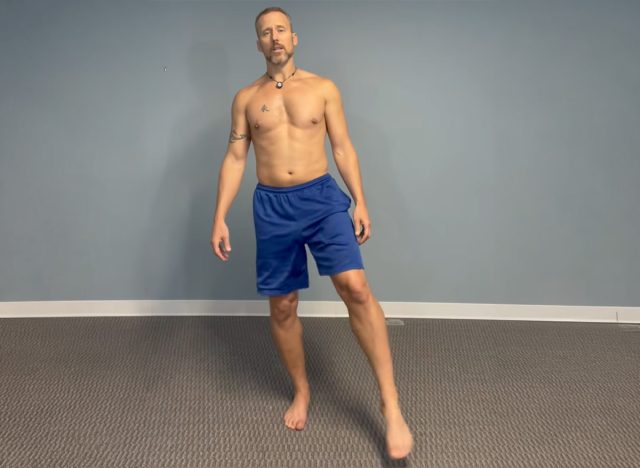
Fascial movements
We begin with vibration, which moves blood and lymph fluid and receives information flowing through the fascia. It’s a simple way to loosen up and loosen up a limb before asking it to do something more demanding.
How to do it:
- Start by gently shaking one leg, then let the vibration move up your knee, hip, and pelvis until your whole leg is shaking.
- Keep it comfortable, not tight. Swing one leg for 20 to 30 seconds, then switch sides and repeat the same pattern from the leg up.
- Next move to your hand. Start shaking one arm, then let it move to the forearm, bicep, and shoulder until the whole arm relaxes and almost falls.
- Shake each arm for 30 to 60 seconds, then switch sides.
- Bring both arms back, add your legs, and let your head move freely so that your whole body vibrates and relaxes at once.
Avoid these mistakes:
- Do not force or control the movement. Let it move freely instead of thinking about tension.
- Do not jump from one limb before the movement is complete. Let it be built gradually from the feet or hands upwards.
Sets and reps: 20 to 30 seconds on one leg, 30 to 60 seconds on one arm, then a final round shaking your entire body. The entire duration takes about three minutes.
Form tip: You’re not just moving your limbs, you’re awakening your proprioception, the connection between your fascia and your brain.
March in place
This will help get your heart rate up and build postural awareness before the rest of the routine.
How to do it:
- Think about maintaining a nice tall spine by standing tall and moving in place.
- Add a gentle bite from your chin and into your pelvic floor as you march.
- March for one to three minutes to gradually get your heart rate up and pumping.
- As you get comfortable, march higher, move faster, or add isometric holds for more challenges.
Avoid these mistakes:
- Don’t let your stance get compromised while marching. Keep that high spine, chin, and pelvis straight throughout the set.
Sets and reps: One to three minutes.
Form tip: Increase the difficulty gradually, higher knees, faster speed or occasional isometric holds instead of jumping straight into intensity.
Take the spine and open
This is the rotation and opening for flexibility and movement through the spine.
How to do it:
- Gently tuck your chin in, then roll through your neck, upper back, mid back, and back, up through your spine to your calves and the soles of your feet.
- Reverse the movement, slowly straightening through the back, middle, upper back and finally the head and neck.
- Repeat slowly and smoothly, working through every range of motion you have.
- Increase the speed when it feels comfortable.
Avoid these mistakes:
- Don’t rush any part of your spine through the roll. Segment each piece even as you move faster.
Sets and reps: Two to three minutes.
Form tip: Work on whatever range of motion you currently have. There is no need to force a roll deeper than your body allows.
Windmill
This windmill stretches the entire body, including the core and inner thighs, and creates more circulation.
How to do it:
- Take a wide stance with your legs straight and your arms up.
- Reach down and touch your toes. If you can’t get that far, getting down on one knee works just as well.
- Increase the speed as you become more comfortable.
Avoid these mistakes:
- Don’t push your reach beyond what your body will allow. A good adjustment is to come to your knees instead of your toes.
- Don’t turn this into a hard push. The goal is to warm up the tissue and move the fluid, not strenuous exercise.
Sets and reps: One to three minutes.
Muscles trained: Leaves, inner thighs.
Jumping jacks
These are just good old jumps and they get your heart rate up and fire up all your muscles to generate more heat in the tissues.
How to do it:
- Do standard jumping jacks for one to three minutes.
Sets and reps: One to three minutes.
Finish as you started
” src=”https://www.eatthis.com/wp-content/uploads/sites/4/2026/07/Fascial-Shaking-exercise2.jpg?quality=82&strip=all&w=640″ alt=”TJ Pierce. Fascial-Saking-exercise” width=”640″ height=”469″ srcset=”https://www.eatthis.com/wp-content/uploads/sites/4/2026/07/Fascial-Saking-exercise2.jpg?quality=82&strip=all 1200w, https://www.eatthis.com/wp-content/uploads/sites/4/2026/07/Fascial-Shaking-exercise2.jpg?resize=640,468&quality=82&strip=all 640w, https://www.eatthis.com/wp-content/uploads/sites/4/2026/07/Fascial-Shaking-exercise2.jpg?resize=768,563&quality=82&strip=all 768w, https://www.eatthis.com/wp-content/uploads/sites/4/2026/07/Fascial-Shaking-exercise2.jpg?resize=1024,750&quality=82&strip=all 1024w, https://www.eatthis.com/wp-content/uploads/sites/4/2026/07/Fascial-Shaking-exercise2.jpg?resize=272,199&quality=82&strip=all 272w, https://www.eatthis.com/wp-content/uploads/sites/4/2026/07/Fascial-Shaking-exercise2.jpg?resize=473,346&quality=82&strip=all 473w, https://www.eatthis.com/wp-content/uploads/sites/4/2026/07/Fascial-Shaking-exercise2.jpg?resize=684,500&quality=82&strip=all 684w, https://www.eatthis.com/wp-content/uploads/sites/4/2026/07/Fascial-Shaking-exercise2.jpg?resize=343,250&quality=82&strip=all 343w, https://www.eatthis.com/wp-content/uploads/sites/4/2026/07/Fascial-Shaking-exercise2.jpg?resize=244,178&quality=82&strip=all 244w, https://www.eatthis.com/wp-content/uploads/sites/4/2026/07/Fascial-Shaking-exercise2.jpg?resize=183,133&quality=82&strip=all 183w, https://www.eatthis.com/wp-content/uploads/sites/4/2026/07/Fascial-Shaking-exercise2.jpg?resize=400,293&quality=82&strip=all 400w, https://www.eatthis.com/wp-content/uploads/sites/4/2026/07/Fascial-Shaking-exercise2.jpg?resize=800,586&quality=82&strip=all 800w” sizes=”(max: 640px) 1040w” /
Once you’ve completed your jump jacks, you’ll bounce back again. This will help everything to relax again and retain the fluid you just moved.
The entire routine should take you between eight and ten minutes. Give it a try next time you’re feeling down.


