
Posted on March 9, 2026 12:26 p.m
Chaturanga Dandasana (Four-legged stick pose) completely contradicts the popular belief that yoga is equivalent to contortionism. Rather, this asana is about keeping everything in one piece: The hands and feet touch the ground, while the body hangs in one unit above the ground, as in a calisthenics push-up. The strength required to perform Chaturanga Dandasana is not as important as the ability to integrate and organize the individual elements of the body so that they function together.
The word “integrity” comes from Latin to combinewhich means to renew or restore. Physical integrity is the renewal or restoration of the original integrity of the body. This integrity refers to the coordination of movements, the connection between structures such as the legs and the spine. It also implies a balance of strength, flexibility and relaxation, creating a perfect tension between these three qualities. When this perfect tension isn’t there, we feel disconnected or just “gapped”.
Perhaps the reason Chaturanga disappoints so many people new to yoga is that it can only be done if there is a strong unifying force throughout the body, head to toe and front to back. The unifying force through the length of the body comes primarily from the support of the arms and the propulsive power of the legs. It also comes from the relationship between the soft front body (throat, lungs, abdominal organs) and the hard back body (spine, rib cage, and pelvic girdle).
One of the ways we establish a proper relationship between our front and back bodies is by allowing our core muscle reflexes to work for us, not against us. Reflexes are a force that contributes to postural tone, background muscle activity below the level of voluntary muscle contraction.
Preparation for Chaturanga
In the following preliminary exercise, we will learn how this reflex can unify our body to prepare us to practice Chaturanga Dandasana.
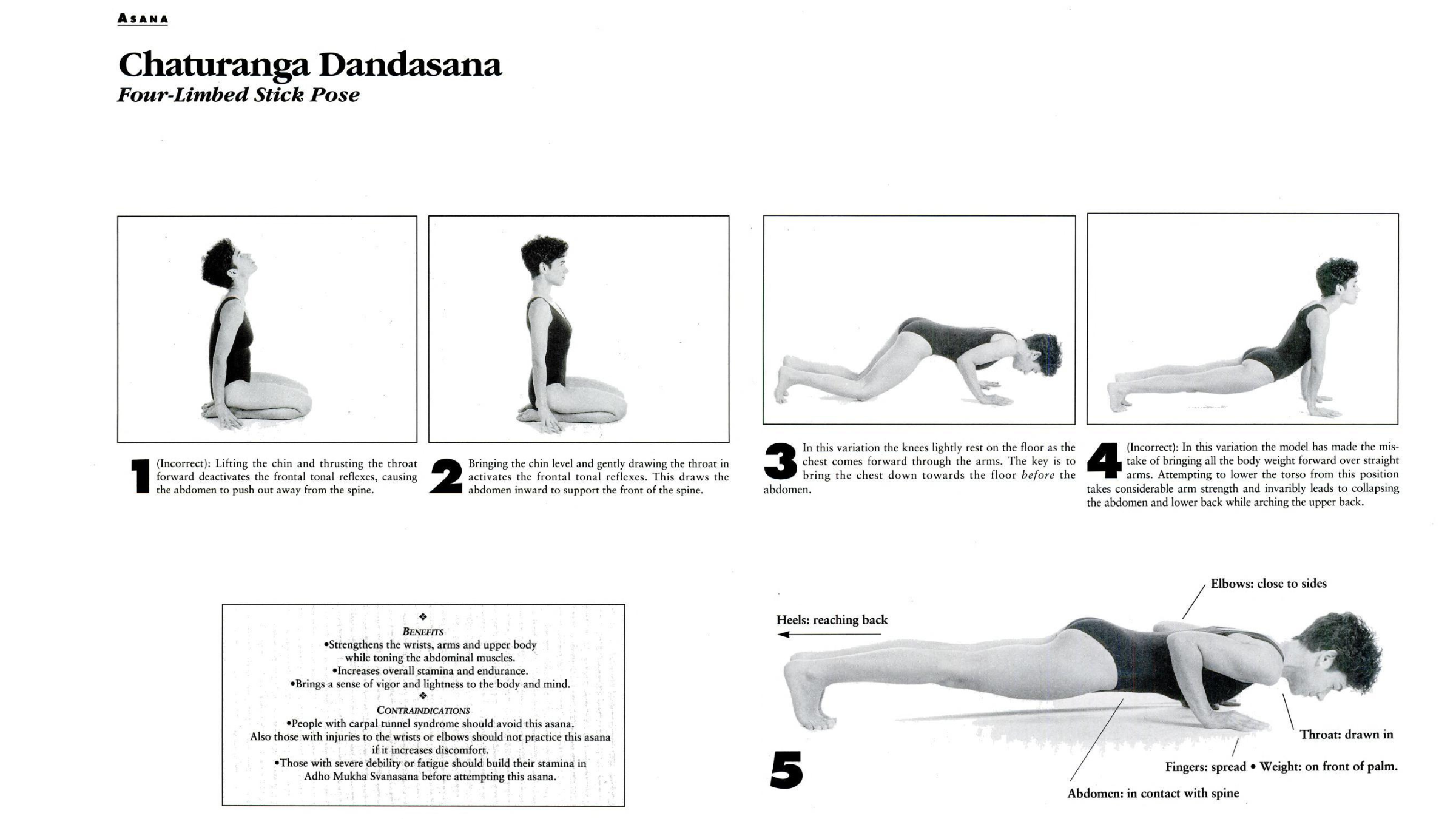
Kneel or sit on top of a blanket. Begin by sitting upright with the crown of the head balanced over the center of the abdomen. Lift your chin and hang your neck forward (Figure 1). Have you noticed that your stomach is automatically protruding? Now slowly pull back the front of the throat as if swallowing or sucking, slightly covering the chin (picture 2). You may even want to pout or press the lips together to stimulate the reflex. Have you noticed that the abdomen automatically moves towards the spine? Go back and forth between these two positions, pulling the collar forward and then pulling it back.
How to practice Chaturanga
Chaturanga Dandasana is usually performed as follows Downward facing dog (Adho Mukha Svanasana). Many common mistakes in Chaturanga Dandasana are simply bad habits picked up from Down Dog. The following exercise will focus your attention on the correct positioning of the arms and hands. Keep this awareness in mind while progressing to Chaturanga Dandasana.
Kneel on all fours and place your hands in front of you, shoulder width apart. Place your hands carefully so that the palms of your hands are parallel to the wall in front of you. Do not turn the arms in or out, extend the fingers so that they radiate in all directions. This action will help to distribute the weight of the body on a wider basis. Make sure you are putting as much pressure on the inner wrist as the outer wrist. Exercising the outside of the arms in these difficult positions will cause pain and injury to the arm.
Finally, lift the arms up until the palms are almost off the floor. This action allows the weight of the body to be lifted by the front part of the palm and fingers, and not just by the base of the hand. After a minute, sit back in child’s pose and relax the arms completely.
Never do exercises like Chaturanga Dandasana on soft carpets or on sand where the hands are above the level of the fingers. This hyperextension can cause immediate discomfort and in the long term can contribute to serious conditions such as carpal tunnel syndrome, where pressure on the median nerve in the wrist area causes pain, numbness and muscle weakness.
Initial version of Chaturanga
Kneel on all fours again and carefully position the hands as described above. Sit back so that the heels rest lightly on the heels and the toes are under the feet.
Bring the head and chest close to the floor and pull the front of the throat to the neck, as you did in the previous exercise. This practice increases muscle tone throughout the front of the body, especially along the abdominal muscles. Keeping this front support, move the chest forward through the hands, dropping the chest to the floor in front of the abdomen (Figure 3). This point is important because if your stomach hits the floor first, your upper back will be arched. It will then be very difficult to lower the chest to the floor without breaking the lumbar spine.
As soon as the trunk begins to move forward, bend the elbows, keeping them close to the ribs. Imagine the torso and elbows moving as two trains in opposite directions. As the head comes forward in front of the hands, continue in a circular motion to the top and return to the starting position on all fours. The pelvis and abdomen should lead the ascent. Maintain a sense of connection between the front and back of the body as you climb to prevent yourself from collapsing and breaking the strong line through the central axis of the body.
One of the most common mistakes in Chaturanga Dandasana is to pull the chest and head all the way forward into the straight arms. Since it’s more work for the arms to lower yourself from this position, you’ll always try to arch your back and lower your abs to the floor first (fig. 4-wrong). You can avoid this problem by coordinating the movement of the front of the chest with the bending of the elbows.
Now try the pose again, this time focusing on your arms and hands. Make sure the elbows don’t extend out to the sides as you come forward, this will cause the shoulders to roll in and the weight to fall on the outer wrist. When you cross your chest through your hands, be especially careful not to raise the front part of the palm and not to touch the base of the hand. By keeping the pressure on the front part of the palm and fingers, you not only avoid stress on the hands, but also activate the shoulders and upper chest.
A little attention at this early stage of the experience will go a long way in preventing painful hand injuries. Just as practicing Down Dog prepares you for Chaturanga Dandasana, practicing Chaturanga Dandasana with handstand prepares you for advanced arm balances such as Crane pose (Bakasana). What you learn in the simpler poses will naturally be incorporated into the more complex poses.
Advanced version of Chaturanga
Start like the previous option, except this time, when you bring the head from the hands, lift the knees from the floor (picture 5). Slide the legs back until the legs are completely straight and extend through the heels. Breathe evenly, stretching through the head and heels.
To come out of the pose, pull the chest further away from between the hands and lift in an upward circular motion and back to downward facing dog.
As it is important for the health of the spine not to enter this asana with your back arched, instead use the muscles behind the spine to come out of the pose using your arms, chest and abdominal muscles. Make sure to keep your back straight. If you activate the front part of the body, then the muscles of the throat and abdomen feel connected to the front of the spine, the back feels less pressure. If you find that you do not have the strength of the arm to straighten the legs, touch the knees to the floor and try to get out with the integrity of the spine. If you work from a place of spinal integrity, you will progress much faster and gain strength and coordination. Conversely, you will be weak in the arms and upper body as well as straining the back if you insist on arching the spine to get out of the pose.
In the final variation of Chaturanga Dandasana, come forward from downward facing dog with straight legs. Keep a strong heel lift throughout your descent to lengthen the lumbar spine. Move the elbows toward the feet and in toward the ribs. When you are able to hold the body as a unit, the driving force moves from the hands to the feet and from the crown of the head to the tailbone so clearly that an unexpected lightness fills the body. This relief is a good indication that you have indeed integrated your many parts into a whole.
Achieving this kind of body integration takes time and may be more difficult than the measurable goal of flexibility. Taking something apart (as many novice mechanics have discovered) is often easier than putting it back together. For students with very loose ligaments and very flexible bodies, poses like Chaturanga Dandasana can be as much of a mental challenge as a physical challenge.
It took at least a year of practice before I landed myself in Chaturanga Dandasana. I remember the moment as clearly as a stone of life. A lot of other things in my life seemed to “come together” after that, as if the connection between my tissues was creating mental stability.
Necessary constraints and constraints balance movement and freedom, just as the molecular force between particles acts to unite them into a whole. The interplay between flexibility and integrity and the ongoing adjustment of each by the other is part of the process of restoring wholeness that we call yoga.
The lessons we learn from the difficult struggle to balance these diametrical qualities are what we will carry with us when we leave the yoga mat.


