

When you treat recovery as a reward for high effort, you only allow yourself to quit after being pushed, your nervous system never drops its guard. The secret to staying healthy is not accidental. It builds a stable infrastructure for physical balance right into your everyday life.
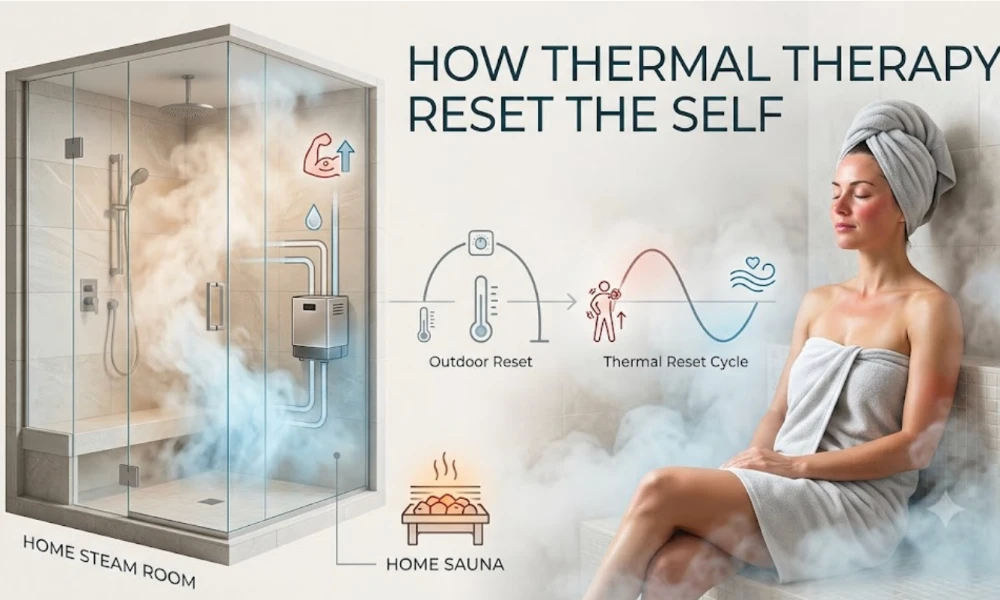
To understand how to truly regenerate, we need to look at the intersection of human biology and environmental design. By looking at how we manage heat both in the spaces we build and within our own bodies. We can open the plan for the highest sports and mental performance.
Heat balance engineering
To understand why heat is a powerful tool for human regeneration, it helps to look at a parallel problem in architectural engineering: keeping a huge building comfortable.
In large-scale commercial heating, engineers encounter a phenomenon known as the residual heat effect. As the boiler draws steam into massive cast iron radiators, the heat doesn’t stop when the thermostat is turned off. The metal stays hot, the energy traps the radiation, and the room temperature rises. If the system waits until the room is completely cool before turning on, the temperature will fluctuate wildly.
To solve this, advanced architecture systems do not wait for internal freezing. They use external reset controls. By placing a sensor outdoors, the system anticipates changes in the weather and modulates its energy production in microcycles. It creates a smooth and constant heat base rather than a chaotic bunch.
Our organs require exactly this kind of architectural approach.
If you wait until you’re completely burned out, suffering from severe muscle damage, or chronically exhausted in search of recovery, you’re forcing your internal system through massive vibrations and stress. Real physical and mental maintenance requires a constant and predictable attitude. You need an environment that gently regulates your indoor climate before you crash.
What happens when the body recovers?
When you step into a specially heated environment, such as a steamy home shower, you effectively activate your body’s internal reset control. You don’t force change through sheer willpower; you let the environment architecture do the work for you.
When trapped in constant heat and humidity, your physiology goes through three distinct phases:
1. Dilation of blood vessels and muscle washing
Your blood vessels dilate (open wider) under the influence of heat energy. This immediately reduces peripheral resistance and allows oxygen-rich blood and nutrients to flow freely into tight, tired muscle tissue. Whether you’re sustaining tension from intense weight training or sitting at a desk for eight hours, this increased circulation speeds up the removal of metabolic waste and gets the building blocks of tissue repair right where they need to be.
2. Automatic reduction
Your nervous system is constantly scanning your environment for signs of safety. Cool, loud noises and bright screens indicate an alert state (sympathetic nervous system). A deep, penetrating warmth is one of the first signs we have for safety. Getting yourself steamed signals your body to go into parasympathetic mode, a “rest and digest” mode where true cellular regeneration and anxiety reduction takes place.
3. Optimizing the core temperature for sleep
It may seem counterintuitive, but warming up your body is one of the best ways to cool it down. Spending 15 minutes in a steam room draws the blood out of your core and into your skin. That heat dissipates quickly when you step outside. This sudden drop in body temperature mimics the natural change in circadian rhythm that occurs right before you fall asleep, signaling your brain to enter deeper, more restorative sleep cycles.
Neurochemical decline
Recovery is not just physical; it is profoundly neurological. Your brain is constantly scanning your environment for signs of safety. Cold weather, loud noises and blue screens signal a state of alertness (activation of the sympathetic nervous system). Heatstroke is one of our primary biological signals for safety.
When exposed to extreme heat, your brain undergoes an interesting chemical process known as the endorphin-dynorphin loop. The initial heat discomfort causes the release of dynorphins, which temporarily makes you feel uncomfortable. In response, your brain rapidly adjusts its mu-opioid receptors.
The moment you let off steam and cool off, your system is flooded with endorphins and a massive drop in cortisol (the main stress hormone). This chemical flip-flop is what creates the legendary, calming “after-glow” and shifts your nervous system from “go-away mode” to true, deep relaxation.
Designing a workspace for health
If the benefits of heat recovery come from frequency and consistency rather than intensity, then accessibility is everything. The reason advanced wellness spaces are moving from commercial suites to residential accommodations is simple: drag kills habits.
If recovery requires you to fight traffic across town and navigate a crowded public facility, you’ll only do it when you’re desperate. But when A home steam room or Traditional sauna built directly into your living space, restoration becomes easier.
By enhancing the spaces we already use, turning a normal daily routine into a sensitive sanctuary with warmth, clean design and calm, we create a secure boundary between the demands of the outside world and our sanctity.
Stop treating your well-being as a manageable crisis. Look at the architecture of your day, introduce a predictable cycle of thermal recovery at home, and let your body remember what it feels like to sit in perfect balance.
- About the Author
- Latest news

Our editorial team are writers and experts in their field. Their views and opinions are not necessarily those of Wellbeing Magazine. If you are under medical supervision, talk to your doctor or therapist before following the advice and recommendations in this article.


